What PK Deficiency Does to a Bengal Cat
Your Bengal has always been a blur of climbing and chasing, and then one week they sleep through dinner and their gums look strangely pale. A vet mentions anemia and then a term you have never heard: pyruvate kinase deficiency. This guide explains what PK deficiency actually does inside a Bengal cat, how it shows up, how vets confirm it and what living with it looks like.
What PK Deficiency Is
Pyruvate kinase deficiency, usually shortened to PK deficiency or PKD, is an inherited condition that affects red blood cells. It is not contagious and it is not caused by anything an owner did. It is written into the cat’s genes from the start.
The Enzyme Red Blood Cells Rely On
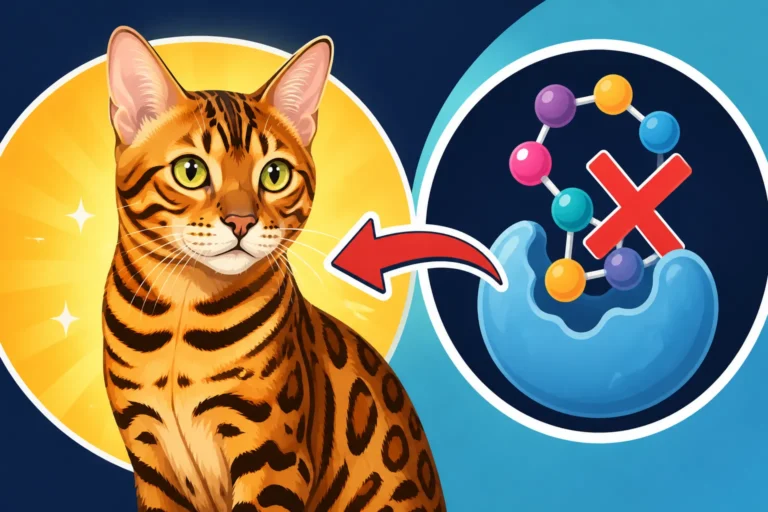
Red blood cells carry oxygen around the body, and they need energy to stay flexible and intact while they do it. Unlike most cells, mature red cells have no mitochondria, so they depend almost entirely on one chemical pathway, called glycolysis, to make that energy. Pyruvate kinase is one of the key enzymes in that pathway.
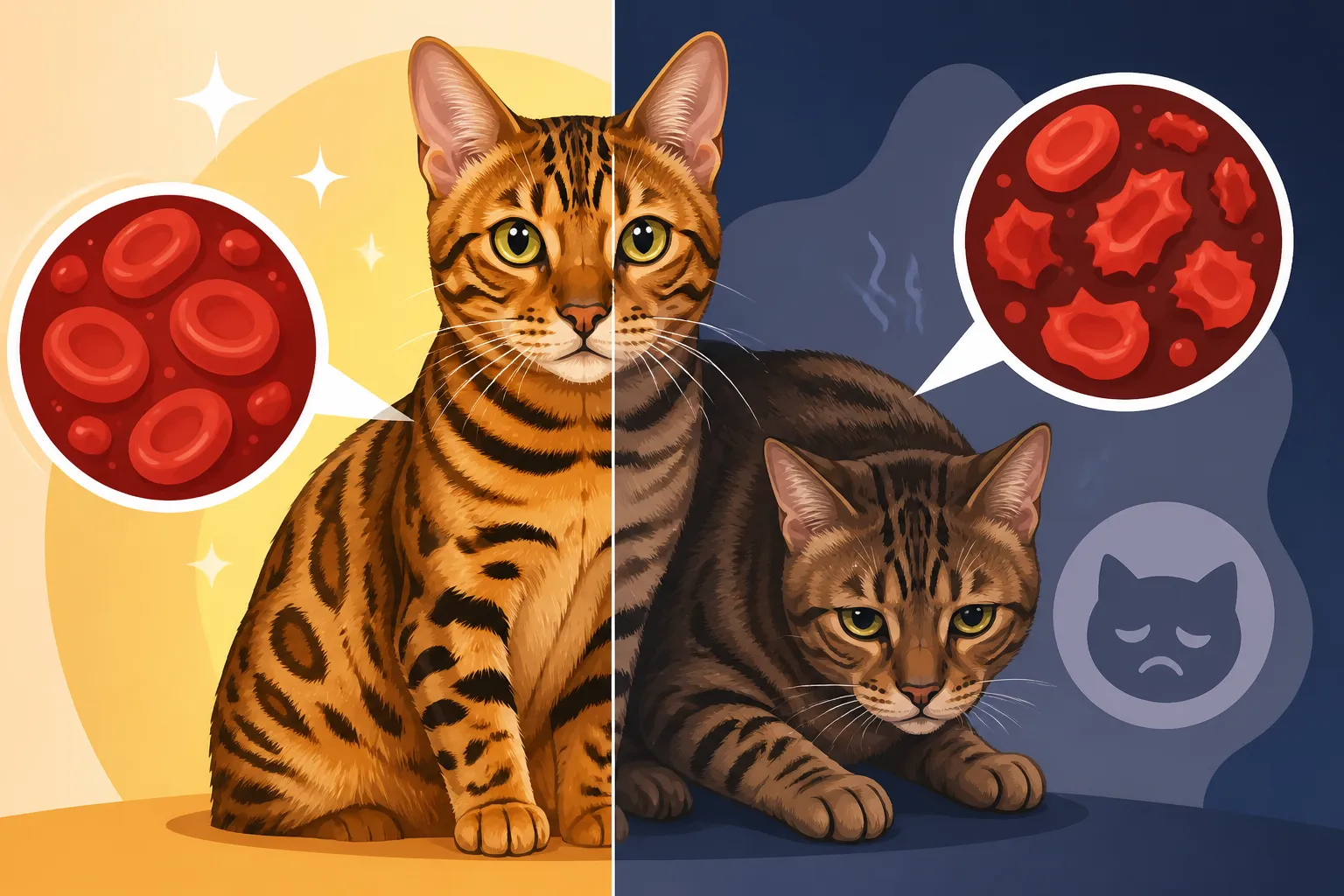
When a cat inherits two faulty copies of the gene for the red cell form of this enzyme, its red blood cells cannot produce enough energy. They become fragile and are removed from circulation much sooner than normal, mostly by the spleen. The site’s piece Which Enzyme PK Deficiency Removes From a Bengal Cat goes deeper into the biochemistry for owners who want it.
How the Disease Is Inherited
PK deficiency in cats is inherited as an autosomal recessive trait. That means a cat needs two copies of the mutation, one from each parent, to be affected. A cat with one normal copy and one mutated copy is a carrier. Carriers do not develop the disease, but they can pass the mutation to their kittens.
When two carriers are bred together, on average about one kitten in four will be affected, about two in four will be carriers and about one in four will be clear. Because carriers look completely healthy, the mutation can spread quietly through a breeding population unless cats are DNA tested.
| Parent Pairing | Clear Kittens | Carrier Kittens | Affected Kittens |
|---|---|---|---|
| Clear and clear | All | None | None |
| Clear and carrier | About half | About half | None |
| Carrier and carrier | About one in four | About one in two | About one in four |
| Carrier and affected | None | About half | About half |
| Affected and affected | None | None | All |
The same mutation has been found in several other breeds, including the Abyssinian and Somali, as well as some domestic shorthairs. See Which Breeds Share the Bengal Cat’s PK Mutation for that wider picture.
What PK Deficiency Does to a Bengal Cat’s Body
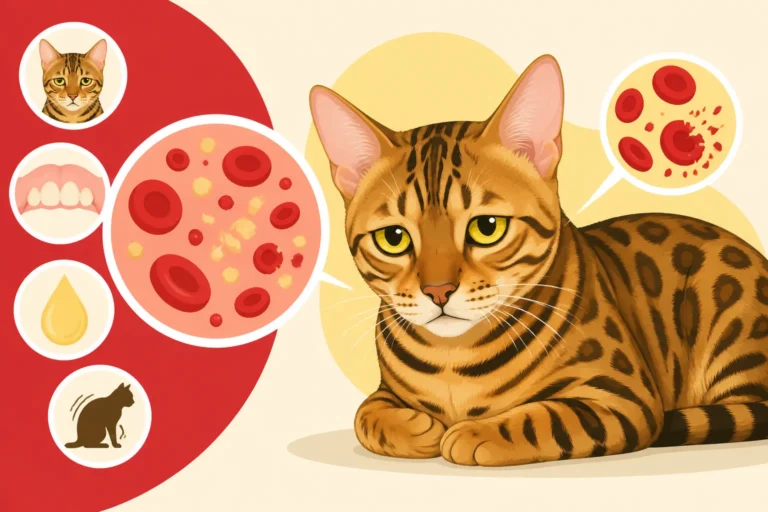
The core problem is hemolytic anemia, meaning red cells are destroyed faster than the body would like. Everything else follows from that.
Red Cells That Break Down Early
In a healthy cat, a red blood cell lasts for a couple of months before it is recycled. In a PK deficient cat, red cells are cleared much sooner. The bone marrow tries to keep up by producing more young red cells, so many affected cats have a regenerative anemia: the count is low, but the marrow is clearly working hard.
In many cats this balance holds reasonably well for long stretches. The cat has a mild anemia that its body has adapted to. The trouble comes when something tips the balance, such as an illness, stress or another cause of blood loss, and the anemia suddenly deepens. The article How PK Deficiency Destroys a Bengal Cat’s Red Cells covers this mechanism in more detail.
Why the Disease Comes and Goes
One of the most confusing things for owners is that PK deficiency often looks intermittent. A cat may seem completely normal for months, then have a bad spell of lethargy and pale gums, then bounce back. These are sometimes called hemolytic crises.
The underlying defect never goes away, but how well the body compensates varies. That is why the site’s guide Why a PK Deficient Bengal Cat Has Good Days and Bad is reassuring for many owners. A good week does not mean the diagnosis was wrong, and a bad week does not necessarily mean the cat is failing.
Effects on the Spleen and Liver
Because the spleen is busy removing damaged red cells, it can become enlarged. A vet may feel this on examination or see it on imaging. The breakdown of so many red cells also releases bilirubin, a yellow pigment, which the liver has to process. During a severe crisis, some cats develop jaundice, visible as yellowing of the gums, the whites of the eyes or the inside of the ears.
Over the long term, the constant turnover of red cells can lead to iron building up in the body and to changes in the liver in some cats. Your vet may want to monitor liver values over time for this reason.
Signs a Bengal Owner Might Notice
PK deficiency can be subtle, especially in Bengals, whose high energy can mask early tiredness. Knowing what to look for helps you get your cat to the vet sooner.
Everyday Signs of Anemia
The most common signs are those of anemia in general:
- Lethargy or sleeping more than usual.
- Reduced interest in play or climbing.
- Pale pink or white gums instead of a healthy pink.
- Poor appetite or weight loss.
- Faster breathing or a quicker heart rate after mild activity.
- Occasional yellow tinge to the gums or eyes during a crisis.
Checking your Bengal’s gum color when they are healthy gives you a baseline. Gently lift the lip in good light and look at the gum above a canine tooth. The site’s article Why a PK Deficient Bengal Cat’s Gums Look Pale explains what you are seeing.
The Age Signs Tend to Appear
There is no single age when PK deficiency becomes obvious. Some cats show signs as kittens or young adults, while others are not diagnosed until middle age, sometimes after bloodwork for an unrelated reason reveals a low red cell count. A few affected cats show very few signs at all.
Because of this range, a normal kitten check does not rule PK deficiency out. A DNA test is the only way to know a cat’s genetic status early. For timing patterns, see The Age PK Deficiency Shows in a Bengal Cat.
How a Vet Confirms PK Deficiency
A vet who suspects PK deficiency will want to confirm both that the cat is anemic and that the cause is this inherited enzyme problem rather than something else.
Blood Tests That Point Toward It
The first step is usually a complete blood count. This shows how severe the anemia is and whether the marrow is responding with young red cells. A blood smear lets the vet or lab look at the shape of the cells. Biochemistry tests can show raised bilirubin and help assess the liver and kidneys.
These results point toward a hemolytic process, but they do not prove PK deficiency on their own. Other causes of hemolytic anemia in cats, including blood parasites, immune mediated disease, toxins and certain infections, need to be ruled out. The site’s piece Whether a Blood Test Alone Diagnoses a Bengal Cat explains why one panel is rarely the end of the story.
The DNA Test
A DNA test for the feline PK deficiency mutation is widely available through veterinary genetic labs and is often included in breed panels. It is usually done on a cheek swab or a blood sample. The result tells you whether the cat is clear, a carrier or affected.
For an anemic Bengal, an affected DNA result together with matching blood work makes the diagnosis clear. For a healthy cat, the test tells owners and breeders what to expect and what to avoid in breeding. Many reputable breeders test before pairing cats; the site’s guide What a Bengal Cat Breeder Should Have Tested lists PK alongside the other common screens.
Treatment and Living With a PK Deficient Bengal
There is no cure for PK deficiency in cats, but many affected Bengals can live comfortable lives with supportive care and monitoring.
Supportive Care and Crises
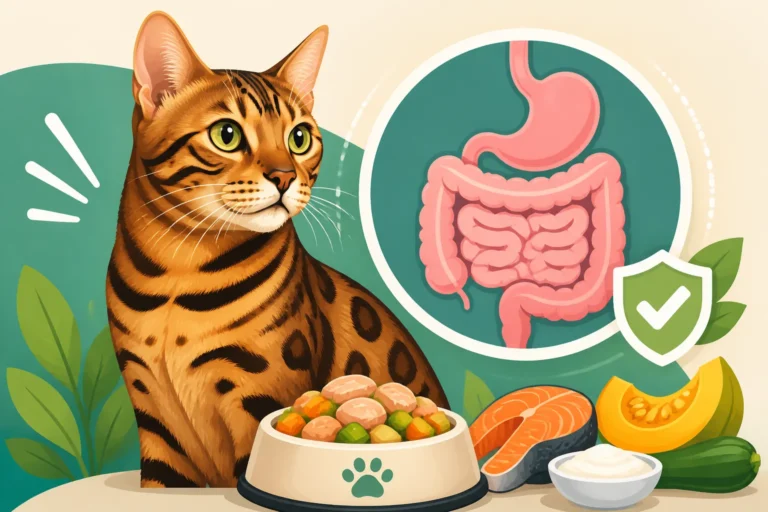
Day to day, treatment usually focuses on keeping the cat stable and reducing stress. That can include regular checkups, periodic blood counts, good parasite control, prompt treatment of any infections and a high quality diet. Your vet may suggest specific supplements or avoid certain medications that can stress red cells.
During a serious crisis, a cat may need hospital care, including fluids and, in severe cases, a blood transfusion. Cats have blood types, so typing and cross matching are important before any transfusion. The article Whether a PK Deficient Bengal Cat Needs a Transfusion covers when that becomes necessary.
When Spleen Removal Is Considered
Because the spleen removes damaged red cells, some vets consider removing it in cats with frequent or severe crises. This surgery, called a splenectomy, has helped some affected cats by slowing the destruction of red cells, though it does not fix the underlying defect and carries its own risks.
This is a decision for a specialist conversation, weighing the cat’s age, overall health and how often crises occur. The site’s piece Whether a Spleen Removal Helps a Bengal Cat goes through the trade offs.
Outlook and Costs
The outlook varies widely. Some PK deficient cats live long, fairly normal lives with only mild anemia. Others have repeated crises and may develop complications over time. Your vet can give you a more personal outlook based on your cat’s blood work and history. See How Long a PK Deficient Bengal Cat Lives for what owners commonly experience.
Ongoing blood tests, emergency visits and possible transfusions add up. If you are considering pet insurance, note that many policies treat any condition showing signs before enrollment as pre-existing. Insurers such as Healthy Paws describe how they handle hereditary and congenital conditions in their policy wording, and terms change, so read the current documents directly rather than assuming. Enrolling a kitten before any signs appear generally gives the most options.
Preventing PK Deficiency in Future Bengals
Because PK deficiency is inherited in a simple recessive way, it is one of the more preventable feline genetic diseases.
What Breeders Can Do
Responsible breeders DNA test their cats and avoid pairing two carriers. Carriers do not have to be removed from a breeding program entirely, since that can shrink the gene pool, but they should be paired only with clear cats. Over a few generations, careful testing can reduce the number of carriers without losing other valuable traits.
The site’s article Whether a PK Carrier Bengal Cat Can Be Bred explains how careful breeders handle carriers in practice.
What Kitten Buyers Should Ask
If you are buying a Bengal kitten, ask whether both parents have been DNA tested for PK deficiency and request to see the results. A breeder who has done this work will usually be glad to share it. If you have an adult Bengal of unknown background, ask your vet about testing, particularly before any anesthesia or if your cat has ever had unexplained anemia.
Knowing your cat’s status early means you can watch for subtle signs, plan for vet care and make informed decisions. PK deficiency is serious, but it is understandable and, with the right information, manageable.
Disclaimer
This article is for general informational purposes only and does not constitute professional advice. Laws, prices and regulations vary by location and change over time. Consult a qualified professional for guidance on your specific situation.