Which Commands a Bengal Cat Learns Fastest
It's a common wonder among Bengal cat owners: with all that energy and sharp intellect, what exactly can these magnificent felines learn to do? If you've ever felt a pang of frustration trying to teach your regular housecat anything beyond "don't scratch the sofa," you'll be delighted and perhaps a little overwhelmed to discover the potential hidden within your Bengal. This comprehensive guide will dive deep into the specific commands that Bengal cats often pick up with surprising speed, offering practical steps and insights into how to harness their unique drive for learning.
The Bengal Cat's Natural Aptitude for Learning
Owning a Bengal cat is truly a different experience from having a typical domestic feline. These cats aren't just pets; they're intelligent, active companions with a wild streak that influences everything from their playful antics to their impressive learning capacity. It's this inherent nature that makes them such fascinating students.
Why Bengal Cats Are Such Quick Studies
Bengal cats are often described as having the intelligence of a dog wrapped in a cat's body, and honestly, it's not far from the truth. Their sharp minds and relentless curiosity mean they are constantly observing, analyzing, and looking for ways to interact with their environment and, most importantly, with you. This isn't just a random trait; it's a direct legacy from their Asian Leopard Cat ancestors, who needed keen intelligence and problem-solving skills to thrive in the wild. This innate cleverness translates directly into their training potential. They don't just mimic; they understand cause and effect surprisingly well. You might notice them experimenting with objects, trying different approaches until they get the desired result, whether it's opening a cabinet door or getting your attention for playtime.
Furthermore, Bengals possess an astonishing amount of energy that demands an outlet. A bored Bengal is often a destructive Bengal, and channeling that energy into training sessions provides crucial mental stimulation that satisfies their active brains. If you've ever wondered How Intelligent a Bengal Cat Is, you'll quickly see it in action during a training session. They thrive on challenges, and learning new commands offers a fulfilling 'job' that keeps them engaged and happy. Their desire for interaction is also a huge factor; they want to be involved in what you're doing, making them highly receptive to joint activities like training.
Understanding Their Motivation: Play, Food, and Affection
When it comes to training any animal, understanding their motivation is key, and with Bengal cats, it's no different. These intelligent creatures respond best to positive reinforcement, meaning they need to see a clear benefit to performing a desired action. Scolding or punishment is not only ineffective but can damage the bond you share and make them wary of future training. Instead, think about what makes your Bengal tick.
For many Bengals, high-value treats are an absolute goldmine. This isn't just any old kibble; think delectable, meaty morsels that they only get during training. Freeze-dried chicken or salmon pieces are often big hits, as are certain soft, chewy treats. The rarity and high appeal of these treats make them powerful motivators. You'll find a clear difference in their focus when they know a special treat is on offer. Beyond food, play is a massive driver for Bengal cats. They are incredibly playful, and the promise of a favorite wand toy session or a game of fetch can be just as, if not more, motivating than food.
Finally, never underestimate the power of your affection. Bengals often form deep bonds with their humans and crave attention. Enthusiastic praise, gentle petting, and a happy voice can be incredibly rewarding for them, especially when combined with treats and play. Observing your cat will help you understand their individual preferences. Some might be absolute foodies, while others are more toy-driven. Tailor your rewards to what your Bengal values most, and you'll unlock their full training potential.
Top Commands Bengal Cats Master Quickly
Given their impressive intelligence and drive, some commands just seem to click faster with Bengal cats than with other breeds. These aren't just parlor tricks; many of them can be genuinely useful for their safety and your peace of mind.
Recall: The Lifesaving "Come" Command
If there's one command every Bengal cat owner should prioritize, it's "come." Bengals are notoriously curious and adventurous, and a strong recall can literally be a lifesaver, whether they've slipped out the door or explored too far on a harness walk. This command taps into their desire for interaction and the rewards you offer.
To start, choose a quiet environment where there are minimal distractions. Begin by sitting a short distance from your Bengal. Say their name clearly, followed by "come," in an inviting, upbeat tone. As soon as they take even a step towards you, mark the behavior (with a clicker, if you're using one, which we'll discuss later) and reward them immediately with a high-value treat and enthusiastic praise. Gradually increase the distance, always keeping it positive and rewarding. If they don't come, don't chase them; simply try again from a closer distance. Never use the "come" command to do something unpleasant, like give medication or put them in their carrier for a vet visit, as this can create negative associations. You want "come" to always mean something good is about to happen. For a more detailed guide, you can look up How to Teach a Bengal Cat to Come.
Fetch: Tapping into Their Inner Hunter
Unlike many domestic cats that might bat at a toy and then wander off, Bengal cats often have a strong retrieve drive, much like a dog. This behavior is rooted in their hunting instincts; chasing, catching, and bringing prey back to a den is a natural part of their ancestral behavior. It makes teaching them to fetch surprisingly easy and incredibly rewarding for both of you.
Start with a toy your Bengal already loves – something small enough for them to carry, like a crinkly ball, a small plush mouse, or even a soft toy from Amazon. Toss it a short distance. If they chase it, praise them. If they pick it up and bring it back, even halfway, heap on the praise and offer a treat. Many Bengals will instinctively bring it right back to you, dropping it at your feet in anticipation of the next throw. If your Bengal needs a little encouragement, you can entice them back with a treat when they have the toy in their mouth. Make fetch a regular game, and you'll be amazed at how quickly they become proficient. It's an excellent way to burn off some of that boundless energy. You might be surprised by How Well a Bengal Cat Fetches once they get the hang of it.
Sit and Stay: Building Foundation for More Complex Tricks
While "sit" might seem like a simple dog command, it's incredibly useful for cats, especially highly active Bengals. It teaches impulse control, helps manage excitement, and lays the groundwork for more complex tricks. Similarly, "stay" builds on this by encouraging patience and focus.
To teach "sit," hold a high-value treat just above your Bengal's head, slowly moving it backward over their nose. As their nose follows the treat, their rear end will naturally lower into a sit. The moment their bottom touches the ground, mark the behavior with your clicker or a verbal marker like "yes!" and give them the treat. Repeat this many times in short sessions. Once they consistently sit when lured, start adding the verbal cue "sit" as their bottom begins to lower. Eventually, they'll associate the word with the action. For more in-depth instruction, see How to Teach a Bengal Cat to Sit.
"Stay" builds on "sit." Once your Bengal reliably sits, ask them to "sit," then hold up an open hand, palm facing them, and say "stay." Take one step back. If they remain sitting, immediately step forward, mark, and reward. If they get up, no fuss; simply reset and try again. Gradually increase the distance and the duration of the "stay," always returning to them to reward before they break the stay. This teaches them that "stay" means waiting for your release, not just holding still until they get bored.
Advancing Their Repertoire: Beyond the Basics
Once your Bengal cat has mastered the foundational commands, the sky's the limit! Their intelligence and athleticism make them prime candidates for learning more intricate tricks and beneficial life skills.
High Five and Spin: Fun Tricks for Mental Stimulation
These fun tricks are fantastic for engaging your Bengal's mind and body, and they're surprisingly easy for such agile creatures. "High five" is a delightful way to interact, while "spin" uses their natural agility.
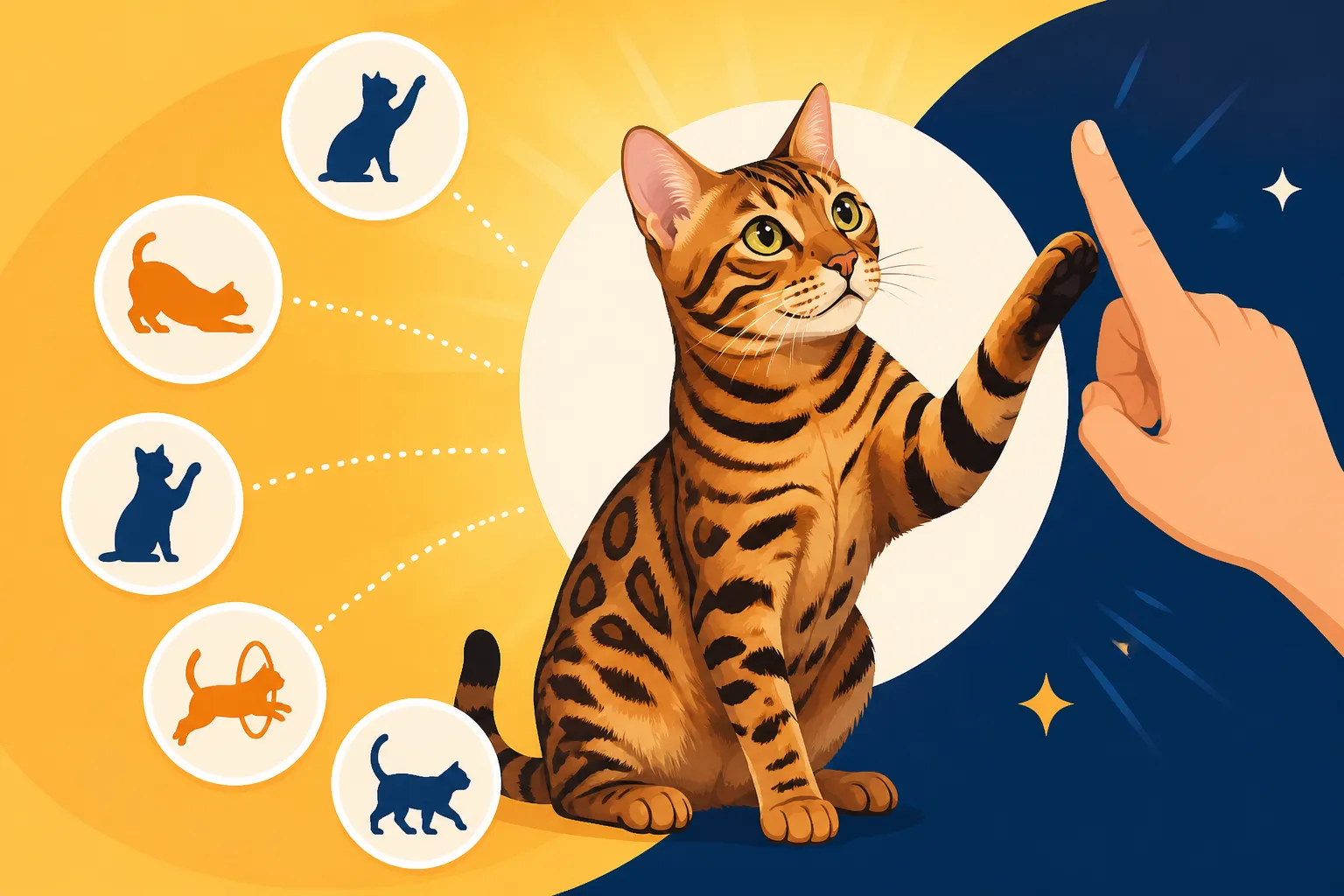
For "high five," start with your Bengal in a sitting position. Hold a treat in your closed fist and present your hand to them. They will likely try to paw at your hand to get the treat. The moment their paw touches your hand, mark and reward. Repeat this, gradually opening your hand so they learn to touch it with their paw. Once they consistently paw your hand, add the verbal cue "high five" as their paw makes contact. You can then extend your open palm for them to tap. It's a charming trick that really showcases their cleverness! Explore How to Teach a Bengal Cat to High Five for more tips.
"Spin" is another crowd-pleaser. With your Bengal standing, hold a treat close to their nose and lure them in a full circle. As they complete the circle, mark and reward. Repeat this several times. Once they consistently follow the lure, start adding the verbal cue "spin" as you initiate the circular motion. Gradually fade the lure, eventually just using your finger to make a circular motion in the air, or simply the verbal command. Both of these tricks not only impress your friends but provide valuable mental exercise for your smart feline.
Leash Training and Harness Acclimation
For an adventurous breed like the Bengal, leash training opens up a world of safe exploration beyond your home. It's not a single command, but a series of learned behaviors and acclimation steps that culminate in enjoyable outdoor excursions. This process absolutely requires patience and a positive approach.
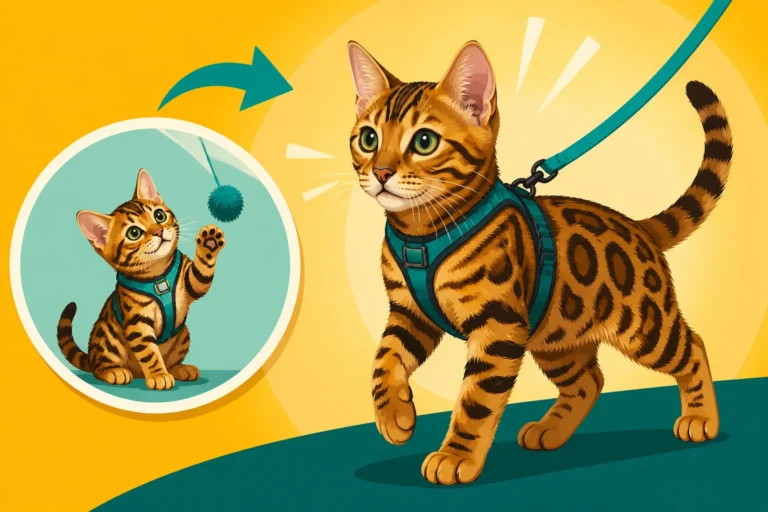
Begin by simply introducing the harness. Let your Bengal sniff it, leave it near their food bowl, and occasionally drape it over them for a few seconds, always followed by a treat. Once they tolerate it, fasten the harness loosely for very short periods (a minute or two), rewarding heavily. Slowly increase the duration until they are comfortable wearing it. Avoid forcing them or making it a negative experience. Many owners find success with harnesses designed for active cats, often available on Amazon, which provide secure but comfortable fit.
Once they're comfortable in the harness, attach the leash and let them drag it around the house under supervision. This helps them get used to the feel. Then, pick up the leash and follow them around without pulling, praising them for moving naturally. Gradually, you can introduce gentle guidance, leading them in a direction for a treat. Always end on a positive note. Once they're walking comfortably indoors, you can try a quiet, safe outdoor space. Patience is truly the key here. More detailed steps can be found in How to Leash Train a Bengal Cat.
Puzzle Solving and Interactive Toys
While not traditional "commands," engaging your Bengal with puzzle feeders and interactive toys teaches them problem-solving skills and satisfies their innate drive to 'hunt' for food or entertainment. These activities are crucial for mental enrichment.
Puzzle feeders, readily available from retailers like Amazon, require your Bengal to manipulate the device to retrieve treats or kibble. This mimics the natural challenge of foraging and prevents them from simply gobbling down their food. Start with easy puzzles and gradually increase the difficulty. You'll be amazed at how quickly a clever Bengal figures out even complex mechanisms. Some popular designs include treat balls, slow feeders with various nooks and crannies, and more elaborate maze-like devices. Consider Whether a Puzzle Feeder Tires a Bengal Cat as part of their daily routine to prevent boredom.
Interactive toys, such as electronic motion toys, laser pointers (used responsibly to avoid frustration), or remote-controlled mice, also provide a fantastic mental and physical workout. These encourage stalking, pouncing, and problem-solving. Rotating toys regularly keeps them fresh and exciting, preventing your Bengal from getting bored with the same old things. Remember, a Bengal who is mentally stimulated is a happy Bengal, and less likely to invent their own, potentially destructive, games.
Keys to Successful Bengal Cat Training
Training a Bengal cat is a journey, not a destination. To ensure success and build a stronger bond with your feline friend, there are a few core principles that you absolutely must embrace.
Consistency, Patience, and Short Sessions
The saying "Rome wasn't built in a day" absolutely applies to training your Bengal cat. These intelligent creatures thrive on routine and clear, consistent expectations. If you teach "sit" one day using a lure and the next you just say the word without reinforcement, your Bengal will become confused and frustrated. Everyone in the household needs to use the same cues and reward systems. Consistency helps them understand what you want.
Patience is equally critical. There will be days when your Bengal just isn't "feeling it," or when they seem to regress on a command they previously mastered. Don't get discouraged or angry. Simply end the session on a positive note (even if it's just rewarding them for sniffing the target), and try again later. Forcing a Bengal to train will only create negative associations and make future sessions harder.
Finally, keep training sessions short and sweet. Bengals have a fantastic attention span for cats, but they are still cats. Five to ten minutes, two or three times a day, is far more effective than one long, grueling session. This keeps them engaged, prevents boredom, and ensures they end each session feeling successful and eager for the next. Always aim to finish on a positive note, even if it's just a simple trick they know well, so they associate training with fun and rewards.
Clicker Training: A Powerful Communication Tool
Many professional animal trainers swear by clicker training, and for good reason: it's incredibly effective, especially for intelligent animals like Bengal cats. A clicker is a small device that makes a distinct, consistent sound. When paired correctly with a reward, it becomes a powerful marker for precise behavior.
Here's how it works: the clicker acts as a bridge. When your Bengal performs the desired behavior, you immediately click, then follow with a treat. The click instantly marks the exact moment they did something right. For example, if you're teaching "sit," the moment their rear touches the floor, you click, then give the treat. The click tells them, "That specific action right now earned you a reward!" Over time, they associate the click with success and positive reinforcement.
The beauty of clicker training is its precision. Your voice can vary in tone, but the clicker's sound is always the same, eliminating ambiguity. It allows you to communicate exactly what behavior you are rewarding, accelerating the learning process. It also helps them generalize behaviors, meaning they understand the command applies in different environments or with different people. If you're serious about training your Bengal, investing in a clicker and learning the basics of its use is highly recommended. For a deeper dive into this technique, check out How to Clicker Train a Bengal Cat.
Avoiding Punishment and Frustration
It's tempting, when your Bengal is being particularly rambunctious or engaging in undesirable behavior (like scaling your curtains or trying to open the pantry for the tenth time), to scold or punish them. However, with Bengal cats, and really all felines, punishment is almost always counterproductive. They don't understand punishment in the same way a dog might; instead, they learn to fear you, hide their actions, or become anxious and stressed.
Instead of punishment, focus on redirecting undesirable behaviors and creating an environment where good choices are easy. If your Bengal is scratching the sofa, provide them with an irresistible, tall scratching post (Bengals love tall ones, often reaching for the sky!) and reward them lavishly when they use it. If they're trying to get into cabinets, invest in childproof locks. You might even find sturdy, interactive toys on Amazon that can distract them.
If your Bengal is exhibiting unwanted behaviors, it often stems from boredom, a lack of mental stimulation, or an unmet need. Address the root cause. Are they getting enough playtime? Do they have enough vertical space to climb? Are their needs for How Much Exercise a Bengal Cat Needs a Day being met? By focusing on positive reinforcement, providing plenty of enrichment, and understanding their unique needs, you'll foster a trusting, happy relationship and encourage them to be the well-behaved, brilliant companions you know they can be.
Here's a quick overview of some common commands and how Bengal cats typically fare with them:
| Command | Bengal Cat Learning Speed | Primary Motivator(s) | Key to Success |
|---|---|---|---|
| Come (Recall) | Very Fast | Treats, Praise, Play | Consistent, positive reinforcement; never use for punishment |
| Fetch | Fast | Play, Treats | Start with favorite toys; make it a game |
| Sit | Fast | Treats, Lure-based | Clear lure, immediate reward |
| Stay | Moderate | Treats, Patience | Gradual increase in duration and distance |
| High Five | Moderate | Treats, Clicker | Break into small steps, reward paw contact |
| Spin | Moderate | Treats, Lure-based | Clear lure in a circular motion |
| Leash Walking | Moderate to Slow | Curiosity, Rewards | Gradual harness acclimation, positive association |
| Puzzle Solving | Fast | Food | Start easy, increase difficulty |
Disclaimer
This article is for general informational purposes only and does not constitute professional advice. Laws, prices and regulations vary by location and change over time. Consult a qualified professional for guidance on your specific situation.