Whether Early Generation Bengal Cats Are Fertile
It's completely natural to wonder about the biology of a breed as unique as the Bengal cat, especially when you hear terms like "generations" and "wild ancestry." Many prospective owners and even some newer breeders feel a bit lost trying to understand what the "F" numbers mean and, crucially, if those early-generation cats can even have kittens. This guide will walk you through the fascinating, and sometimes frustrating, realities of fertility in early generation Bengal cats, explaining why some can breed and others cannot, and what that means for the breed and for you.
Understanding Early Generations in Bengal Cats
Before we dive into fertility, let's clarify what we mean by "early generation." When we talk about Bengal cats, the "F" numbers refer to their filial generation – essentially, how many generations removed they are from their wild ancestor, the Asian Leopard Cat (ALC). It's a fundamental concept that impacts everything from their temperament to, yes, their ability to reproduce.
What F1, F2, and F3 Actually Signify
An F1 Bengal cat is a direct cross between a domestic cat (often an Ocicat or a good quality domestic shorthair in the early days, but now usually an SBT Bengal) and a wild Asian Leopard Cat. They are 50% ALC. These are truly magnificent animals, incredibly striking, but they retain many of their wild traits. You can learn more about What F1 Means in a Bengal Cat if you're curious about their initial development.
Moving down the line, an F2 Bengal cat is the offspring of an F1 Bengal and another domestic cat, making them about 25% ALC. And an F3 Bengal cat is the product of an F2 and a domestic cat, bringing their wild percentage down to around 12.5%. After F3, the term "SBT" (Stud Book Traditional) is used for fourth-generation and subsequent Bengal cats who are fully domestic-to-domestic bred and typically registerable by cat associations like TICA. For a deeper dive, consider reading about What F2 and F3 Mean in a Bengal Cat. This generational progression is really important because it directly correlates with how "wild" their genetic makeup is, and consequently, their fertility.
The Role of the Asian Leopard Cat Ancestor
The entire existence of the Bengal cat breed stems from the initial cross with the Asian Leopard Cat. Understanding What the Bengal Cat's Wild Ancestor Is Like helps contextualize why these early generations possess such distinct traits. The ALC is a small, solitary wild feline native to Asia, known for its incredible agility, hunting prowess, and stunning spotted coat. When these wild genetics are introduced into a domestic cat line, they bring with them not only physical attributes but also behavioral patterns and, critically for our discussion, some reproductive quirks that are common in interspecies hybrids. The very essence of the Bengal's wild look, including those striking rosettes and powerful physique, comes directly from this fascinating ancestor.
Male Fertility in Early Generation Bengal Cats
Here's where things get really interesting, and often, a bit challenging for those looking to breed early generations. The most widely known and significant aspect of early generation Bengal cat fertility is the sterility of the males. It's a biological phenomenon that has profoundly shaped the breeding programs for the entire breed.
The Hybrid Sterility Phenomenon
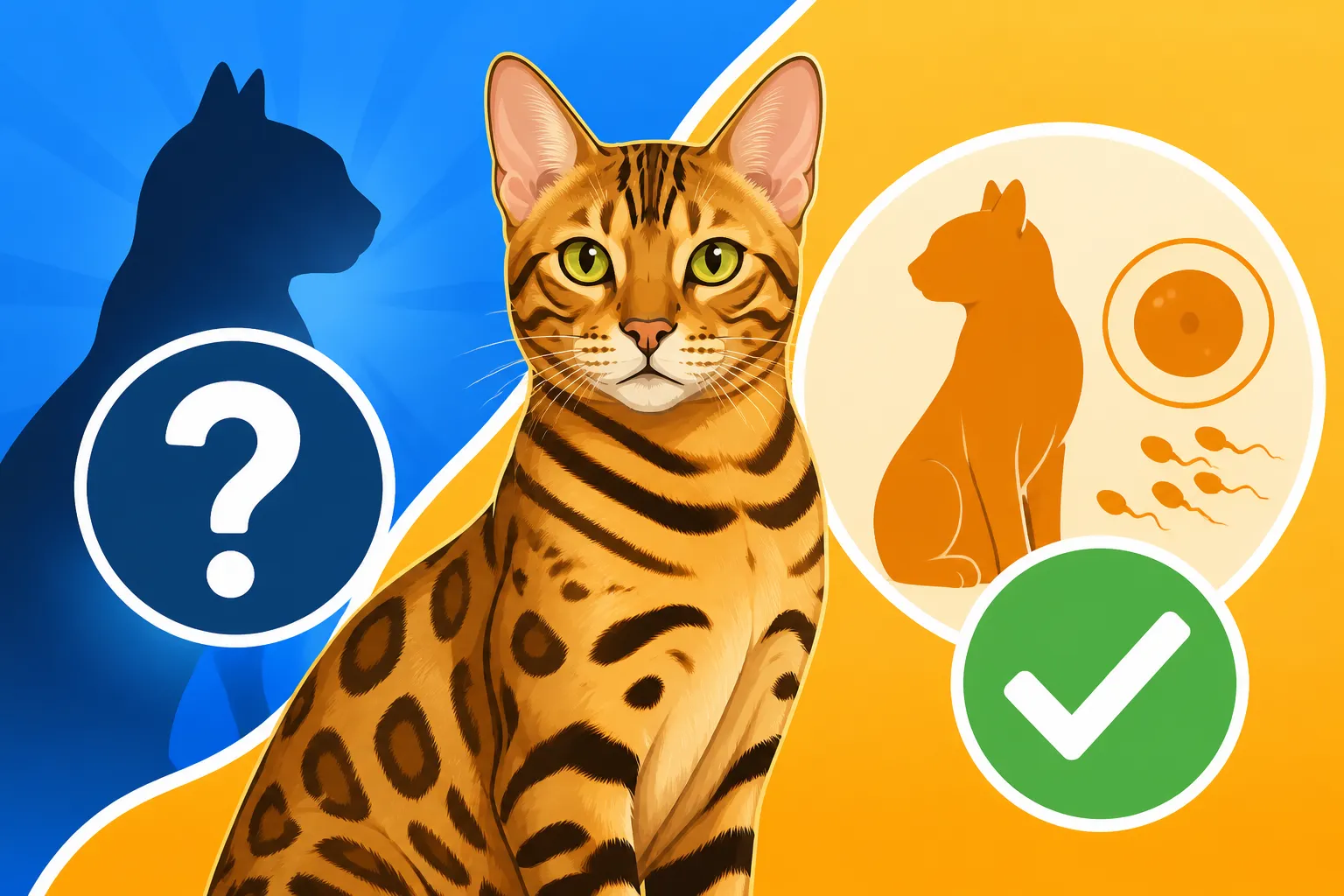
The vast majority of F1, F2, and F3 male Bengal cats are sterile. This means they cannot produce viable sperm and therefore cannot father kittens. This isn't just a Bengal cat thing; it's a common characteristic observed in many interspecies hybrids. Think of mules, for instance, which are a hybrid of a horse and a donkey – they are famously sterile. The scientific term for this is "hybrid sterility," and it occurs because the different chromosome structures from the two parent species (the wild Asian Leopard Cat and the domestic cat) don't align properly during meiosis, the process that creates sperm.
For a breeder trying to establish a new line, this is a huge hurdle. It means that you cannot simply breed an F1 male to an F1 female and expect more F2 kittens. You must always use a fertile domestic male (usually an SBT Bengal or another appropriate domestic breed, especially in the early days) to continue the lineage from an F1 or F2 female. This is precisely Why F1 to F3 Bengal Cat Males Are Sterile. It's a genetic roadblock that means the female line is absolutely paramount in advancing the breed.
Impact on Breeding Programs
This male sterility has a massive impact on how Bengal cat breeding programs are structured. Breeders working with early generations must rely solely on fertile F1, F2, and F3 females to carry the line forward. Each time, they must breed these females back to a fully fertile domestic Bengal stud, typically an SBT (Stud Book Traditional) Bengal. This constant "breeding down" to dilute the wild genes and regain fertility in the males means that the progression from F1 to F4 (SBT) is a careful, multi-generational process.
It also means that the genetic pool for traits from the male side in early generations is always from the domestic cat, not directly from the Asian Leopard Cat beyond the initial cross. This helps solidify the domestic temperament while retaining the exotic looks. It also explains why you'll rarely, if ever, encounter an F1, F2, or F3 male being offered as a pet, let alone for breeding – they simply cannot breed. Their role in the breed's history is significant as the initial cross, but their direct genetic contribution to future generations is limited by this sterility.
Female Fertility in Early Generation Bengal Cats
While the males of early generations present a unique challenge, the females are a different story altogether. Generally speaking, F1, F2, and F3 Bengal cat females are fertile, meaning they are capable of becoming pregnant and carrying a litter to term. However, their fertility isn't always as straightforward as with fully domestic cats, and breeding them comes with its own set of considerations.
Fertility and Breeding Challenges in Females
Yes, F1 to F3 Bengal cat females can and do produce kittens. In fact, they are the very backbone of how the breed moved from the initial ALC cross to the fully domestic SBT Bengals we see today. Without fertile F1 and F2 females, there would be no F2s or F3s. However, while they are fertile, breeding them isn't always as easy as breeding a domestic cat.
For F1 females, who are half wild, their breeding behavior can be quite different from a typical domestic queen. They may be more selective about mates, have different heat cycles, or exhibit protective, sometimes aggressive, behaviors during breeding or after giving birth. Their wild instincts are stronger, which can make the process more intense and require experienced handling. For instance, the number of kittens in a litter can vary, and while a typical Bengal cat litter can hold How Many Kittens a Bengal Cat Litter Holds, an F1 might have a smaller first litter.
As you move to F2 and F3 females, these wild traits generally become less pronounced, and their breeding patterns tend to align more closely with domestic cats, but they can still exhibit some unique characteristics. Breeders often need to be very patient and understanding of their unique needs and behaviors to ensure a successful and stress-free breeding experience for the queen. This is also where responsible breeding practices come into play, with careful health screening and temperament assessment being crucial.
Responsible Breeding and Health Considerations
For any breeder working with early generation Bengal cats, responsible practices are paramount. This isn't just about successful litters; it's about the health and welfare of the cats involved and the future of the breed. Ethical breeders will conduct thorough health screenings on both the early generation female and the chosen domestic stud. This includes genetic testing for common Bengal cat ailments like PRA-b (Progressive Retinal Atrophy) and PK Deficiency (Pyruvate Kinase Deficiency), as well as echocardiograms to screen for HCM (Hypertrophic Cardiomyopathy). It's part of What a Bengal Cat Breeder Should Have Tested to ensure healthy offspring.
Beyond genetics, temperament is a huge consideration, especially for F1 and F2 females. Their semi-wild nature means they need careful socialization and handling to ensure they are comfortable and safe during breeding and kitten rearing. Breeders often dedicate significant time and resources to creating an ideal environment for these queens, recognizing that their needs are different from a standard domestic cat. Insurance providers like Healthy Paws can offer peace of mind for breeders or future owners by helping cover unexpected veterinary costs, which are a very real consideration given the unique genetics of the breed.
Implications for Owners and the Breed's Future
Understanding early generation Bengal cat fertility isn't just for breeders; it has implications for anyone interested in the breed, whether as a pet owner or simply a fan of these magnificent felines. The reproductive journey of these early cats has shaped the breed into what it is today.
The Rarity of Early Generation Pets
Because F1-F3 males are sterile and breeding F1-F3 females requires specialized knowledge and environments, these early generation cats are rarely available as pets. Most reputable breeders focus on producing SBT (Stud Book Traditional) Bengals, which are fully domestic and have stable temperaments suitable for family homes. F1s, in particular, often retain significant wild instincts and require a very specific, experienced owner and environment – they are definitely not for everyone. You'll find that How an Early Generation Bengal Cat Behaves Differently can be quite a shock if you're expecting a typical house cat.
If you do encounter an early generation Bengal, especially an F1, F2, or F3, being offered as a pet, it's crucial to understand the responsibilities involved. Their care requirements can be much more demanding than an SBT Bengal, and their legal status can vary significantly by location. In many places, owning early generation Bengals is restricted or even outright banned due to their wild heritage.
Maintaining Genetic Health and Diversity
The sterility of early generation males means that breeders must be vigilant in selecting suitable domestic studs to continue the lineage. This careful selection helps to bring in new genetic lines and maintain overall genetic diversity within the breed, which is vital for long-term health. While it might seem like a limitation, it has in some ways forced breeders to be more strategic about pairing and maintaining robust genetics. Healthy Paws, as a pet insurance option, acknowledges the importance of proactive health management, which includes good breeding practices to minimize inherited conditions.
As the breed moves further from its wild roots, the aim is to retain the striking appearance while fully embracing a domestic temperament and, of course, full fertility in both sexes. The work of responsible breeders ensures that while the initial crosses were a blend of wild and domestic, the Bengal cat of today is a cherished, fully integrated domestic breed. The conversations around Whether Breeding Hybrids Like the Bengal Cat Is Ethical often revolve around these very considerations of health, welfare, and responsible progression. Furthermore, strict rules are in place regarding Whether a New Wild Cross Into the Bengal Cat Is Allowed to control the introduction of new wild blood and maintain the stability of the breed.
The End Result: The SBT Bengal
The ultimate goal of navigating the complex fertility of early generations is to produce the SBT Bengal. An SBT Bengal is at least four generations removed from the Asian Leopard Cat on both sides of its pedigree, ensuring full fertility in both males and females, a consistent domestic temperament, and adherence to the breed standard. This is the Bengal cat that most people know and love – active, intelligent, playful, and affectionate, but without the intense wild instincts or reproductive quirks of their earlier ancestors. They also enjoy a good How Long a Bengal Cat Lives on Average, often into their teens, thanks to careful breeding and health management.
| Generation | Male Fertility | Female Fertility | General Temperament | Pet Suitability |
|---|---|---|---|---|
| F1 | Sterile | Fertile | Highly wild-like | Very low |
| F2 | Sterile | Fertile | Semi-wild | Low |
| F3 | Sterile | Fertile | More domestic | Moderate |
| SBT (F4+) | Fertile | Fertile | Fully domestic | High |
Ultimately, the journey from wild Asian Leopard Cat to the beloved domestic SBT Bengal is a testament to careful breeding and an understanding of unique feline biology. While early generation males are largely sterile, the fertility of their female counterparts allowed the breed to flourish, ensuring that the stunning beauty of the wild ancestor could be preserved in a captivating and affectionate companion cat.
Disclaimer
Please remember that this article is for informational purposes only and should not replace professional veterinary advice. Always consult with a qualified veterinarian or a reputable Bengal cat breeder for specific health or breeding questions.